
The Original Omega Seamaster Professional 300m Blue Wave Dial “Bond Watch”
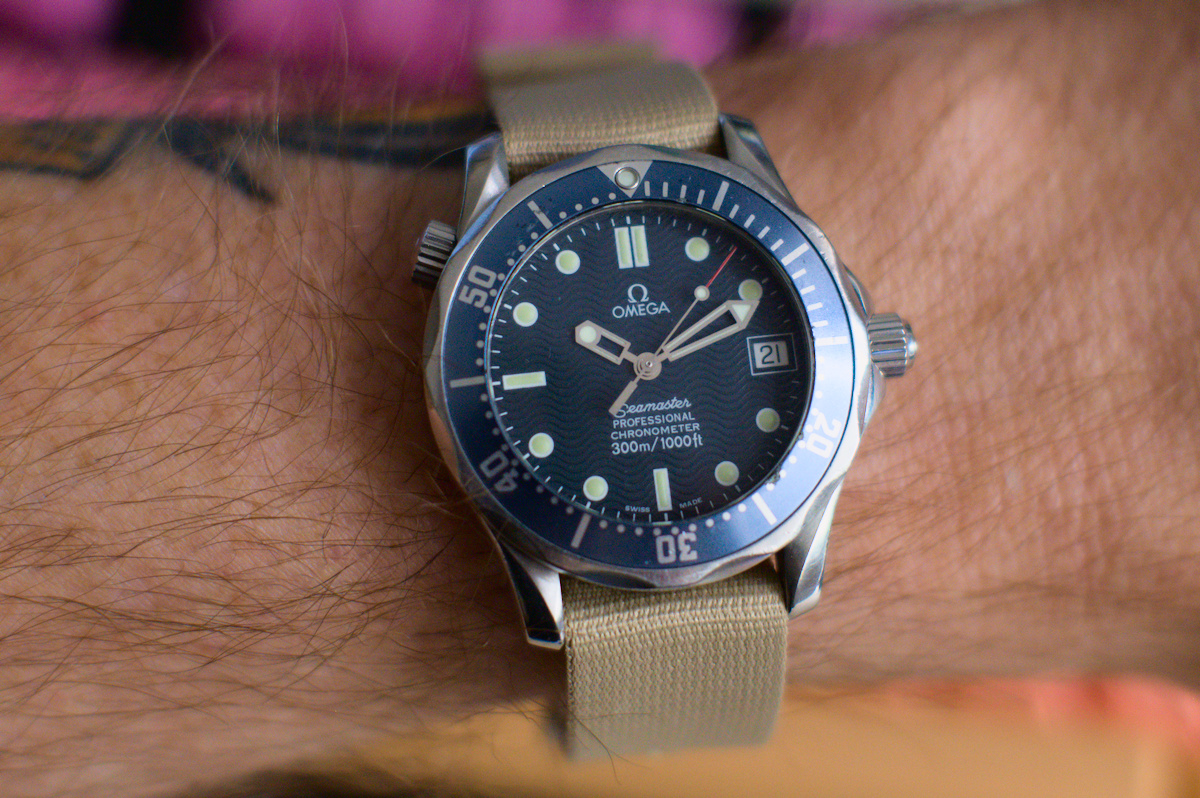 My mid-size original blue wave dial Omega Seamaster Professional 300m automatic
I’ve always been a huge James Bond fan. It started when I saw GoldenEye in the cinema in ’95 and for my last two years of high school, I was actually wearing a suit and tie to school every day. This was the time of my life where I finally began to not care about what others thought of me and started to embrace who I am and what I like instead of what others expect. When I graduated from high school in 2003, my parents gifted me an Omega Seamaster Professional 300m — the one with the blue wave dial that Brosnan wore in GoldenEye and that became known as “the Bond watch”. Mine is the automatic version that Brosnan switched to in Tomorrow Never Dies, which is distinguished by the “chronometer” label on the dial.
I picked the mid-size version of the watch (reference 2551.80.00) that has a rather traditional size when compared to Brosnan’s Bond watch, which was the full-size version that appeals to more modern sensibilities.1 The mid-size version of the watch is distinguished by its proportions and because it is missing the small lumed baton next to the date window at three o’clock. I felt the smaller, traditional size was more unassuming and fit my smaller wrist better. With the years, I have also come to prefer its overall proportions to the full-size version. A famous wearer of the mid-size blue wave dial SMP is Prince William, who was gifted the quartz version by his mother, the late Princess Diana, when he was at Eton.
The Most Beautiful Wristwatch Ever Made
To me, the original blue wave dial Seamaster is the most beautiful wristwatch ever made. I have loved the ocean since I was a little child and I love how this watch represents its dive watch heritage with that deep blue ocean colour and the very subtle waves on the dial that don’t distract from readability of the watch at all. The dot-and-baton design of the hour markers is as simple as it is beautiful. The date window is very readable and has a lovely font. But what I probably love most about these Seamasters is that they are proper dive watches that nontheless eschew much of the brutalist look of their modern compatriots. With its elegant lyre-shaped lugs, these watches are somewhat of a cross between a traditional dive watch and a more elegant watch that is at home during a black-tie dinner. This understated style is amplified in this model by the absolutely gorgeous skeleton hands.
The lyre-shaped lugs and skeleton hands give the Bauhaus simplicity of the dial a lovely art deco twist that I am as much in love with today as when I first saw it on the big screen in ’95. I see the Seamaster’s trademark helium escape valve at 10 o’clock in the same vein: I will obviously never use it for its intended purpose, but it is a nice design flourish that gives the look of the watch a balance that I miss in all other dive watches. All of these design factors are further amplified by the tighter proportions on the mid-size SMP, I feel.
The caseback follows the general theme of the watch and I adore how simplistic, yet stylish it is. Instead of the see-through window in newer Seamasters that shows off the movement, which I personally find unnecessary and actually rather ugly, my Seamaster has a utilitarian stainless steel plate. But it wouldn’t be a classic ’90s / early 2000s Omega if that steel caseback wasn’t subtly decorated. In the case of the Seamasters of that era, it is engraved with the same wave pattern present on the dial as well as the classic Seamaster engraving with a hippocamp and the omega symbol. The hippocamp is associated both with the Ancient Greek god of the sea, Poseidon, as well as with his father, the Titan Cronos, who was the master of time. What better symbol is there to engrave on the back of a watch made for the sea?
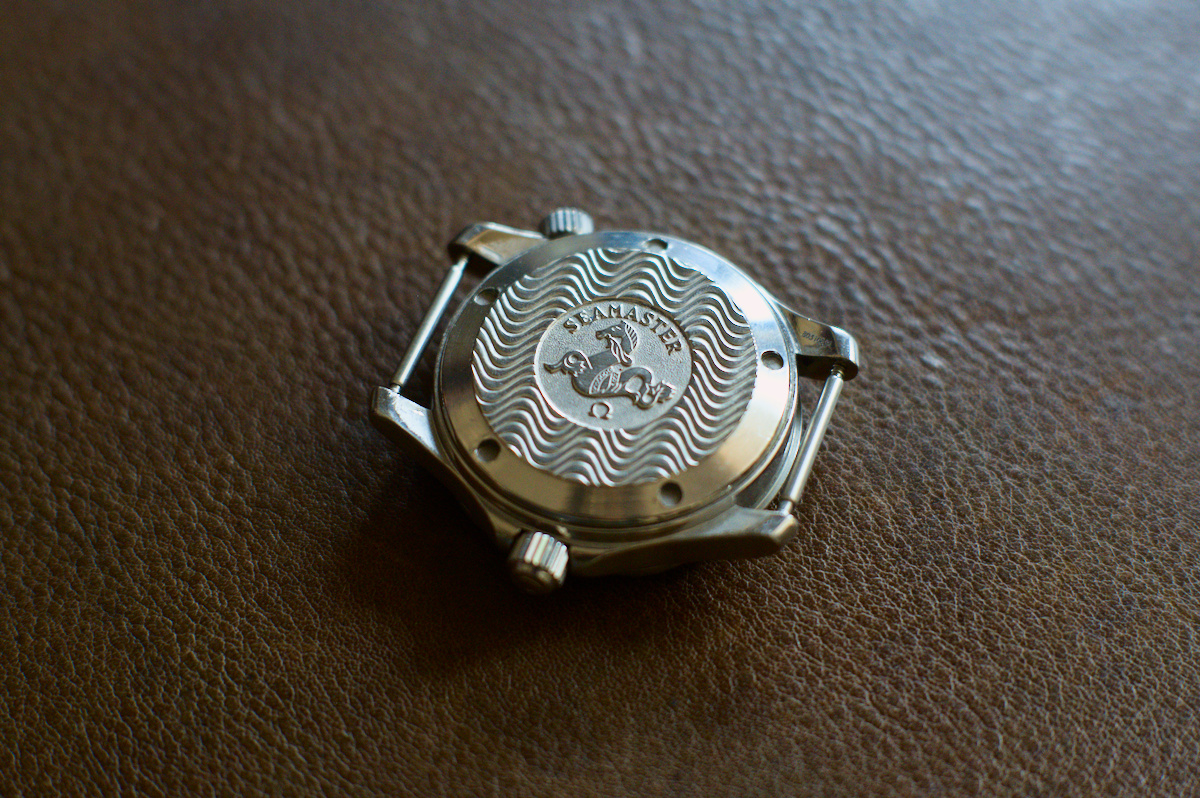 The understated beauty of the ’90s-style Seamaster caseback
Unlike many watch enthusiasts, I actually like the original steel bracelet on the SMP. But when I had worn the watch on that bracelet for almost two decades, I decided to switch it up. Since then, I have been wearing it on a variety of NATO straps in different colours. These are cheap and durable and enable you to easily change the look of your watch. I love NATO straps. Especially since I discovered the, in my mind, superior way to wear these straps: the so-called over-under method.
I’ve Worn This Watch Every Day for 23 Years
My Seamaster Professional has been on my wrist almost constantly since I was gifted it in 2003. I wear it day and night, only taking it off for a few days at a time when it needs to get serviced — which you have to do with automatic watches every couple of years to keep them waterproof and the movement in good working order. This is a quite involved,2 and thus also pretty expensive, process and I’ve spent probably as much on servicing the watch over the decades as my parents originally spent on the thing itself.
I shower with this watch and I always take it swimming with me. The Seamaster has been swimming with me in the Atlantic, the Pacific, the Arctic and the Indian ocean. It has survived a car accident and several motorcycle accidents, including one where my left wrist (with the watch) ended up punching through the back window of a car. None of these adventures has ever caused this watch to stop working accurately. A few years ago, I dropped the watch on a bathroom floor and it stopped working with the seconds hand falling off. I brought it to a watchmaker and got it fixed. Two years ago, the date function stopped working. As it turned out, one of the small gears that drives this function had worn out. My watchmaker fixed that, too. I had the watch serviced in both cases. You might as well when it’s already in the shop and being opened anyway.
You can definitely see that I have been wearing this watch non-stop for 23 years. The aluminium bezel insert is scratched, discoloured in places and has a few chunks broken out of it where it faces the chrystal. It has also faded to a light blue colour that subtly differs from the original, much deeper blue. The dial, the lumen markers and especially the red tip on the second hand have faded too. There are small imperfections on the markers, the hands and the dial itself. Even though you can send your watch in for a service with Omega and they will restore it to as-good-as-new quality, I’ve decided not to do that as I’ve grown quite attached to all of these small imperfections. They tell the story of my watch and all the things I have experienced with it over the years. I have been wearing this watch for more than half of my life and I like that it is showing on the watch itself. Amazingly, the sapphire glass crystal of the watch doesn’t have a single scratch on it after all these years.
In Praise of ETA Calibres
One definite advantage, in my eyes, of these older Seamasters is the calibre. My watch uses the Omega Caliber 1120, which is Omega’s version of the legendary ETA Caliber 2892A2 that powers tons of automatic watches from dozens of manufacturers (both Swiss and others). ETA was a dedicated movement manufacturer for Swiss automatic movements founded in 1856. It finally ended up being merged into the Swatch Group, together with Omega, after Omega has used ETA movements for decades. This is significant because newer Omega watches use their own in-house movements with co-axial escapement, a technology invented by British watchmaker George Daniels in the ’70s and licensed by Omega in 1999. All current Omega watches use this movement.
Now, Omega’s Co-Axial Movement might be a technical improvement on the good old Caliber 1120, but I nonetheless prefer a watch with the latter. Why? Because the ETA 2892A2 has been around for decades and you don’t need special tools or Omega-exclusive replacement parts to service it. Any watchmaker worth their salt can do it. Whereas the Co-Axial Movements from Omega can basically only be serviced by Omega — which in turn means it’s more expensive to service them and you wait much longer to get your watch back. For this simple reason, I would not exchange my humble, beat-up 2003 SMP for the newest, most expensive Seamaster in Omega’s line-up. Not for a long shot.
I love these mechanical movements. I love the engineering, intricacies and beauty of them. I will never wear a smartwatch or something similar. This thing needs no batteries, never stops running, is accurate enough so that you only need to set it about once a week and it can’t be hacked.3 Despite being thought of mostly as a luxury item these days, these dive watches are built to take a beating and still last you a lifetime. Granted, even Seamasters are about three times as expensive now as in 2003 when my parents bought mine, but as long as you stick with the baseline steel-on-steel models, there are still good value for the money. That is, if you intend to buy only one in your lifetime and wear it every day. If you don’t want to spend that kind of money, there are excellent alternatives out there that are quite a bit cheaper; Seiko’s Prospex line, for example.
 Coming out of the surf at Rainbow Beach in Queensland, Australia, in 2006 — with the Seamaster on my wrist (Photo: Katharina Scherschel)
In closing, my 2003 Omega Seamaster Professional has been on my wrist for 23 years (minus a few days in service) and I swam with it in four out of five oceans — and one day, I’ll also dip it into the Southern Ocean. I love this watch. It is probably the one material thing I own that I will never part with.