
Content Tagged “history”
-
Amelia Earhart Overshadowed Better Female Pilots than Herself
Lost in the glare of Earhart’s posthumous elevation to aviation sainthood are the other women pilots of aviation’s golden age who, as much as Earhart, defied the era’s systemic misogyny to prove a woman’s place was in the cockpit. Forgotten is how Earhart substituted courage for competence to achieve fame, and missing is an appreciation of the unique socioeconomic environment that made it possible.
— Ric Gillespie, One More Good Flight: The Amelia Earhart Tragedy
-
While the Propellers Knotted like Pretzels
In 1937, Time magazine had this to say about Amelia Earhart crashing her plane on the second leg of her world-circling flight. The press really hit different back then.
For Earhart and Putnam, the crash in Hawaii was a public relations disaster. The March 29 issue of Time magazine drew on the title of a popular Eugene O’Neill play for a piece titled “Mourning Becomes Electra.” After pointing out that several people had flown around the world on commercial airlines, the article said, “Last week Aviatrix Amelia Earhart Putnam took off from Oakland ‘to establish the feasibility of circling the globe by commercial air travel.’ … With her as navigators she took three men, but not her publicity-wise husband, who stayed at Oakland to sell her autographs at $6 each.” Time’s description of the accident was no less sarcastic: “Down the long concrete runway of Luke Field the ship shot at 60 m.p.h. Suddenly the left tire blew out. Lurching, the plane crumpled its landing gear, careened 1,000 feet on its bottom in a spray of sparks while the propellers knotted like pretzels. With sirens screaming, ambulances dashed to the wreck just as Flyer Amelia stepped out white-faced. Said she, ‘Something must have gone wrong.’
— From the book One More Good Flight: The Amelia Earhart Tragedy by Ric Gillespie, U.S. Naval Institute Press, 2024
-
I Shall Not Hold You to Any Medieval Code of Faithfulness to Me
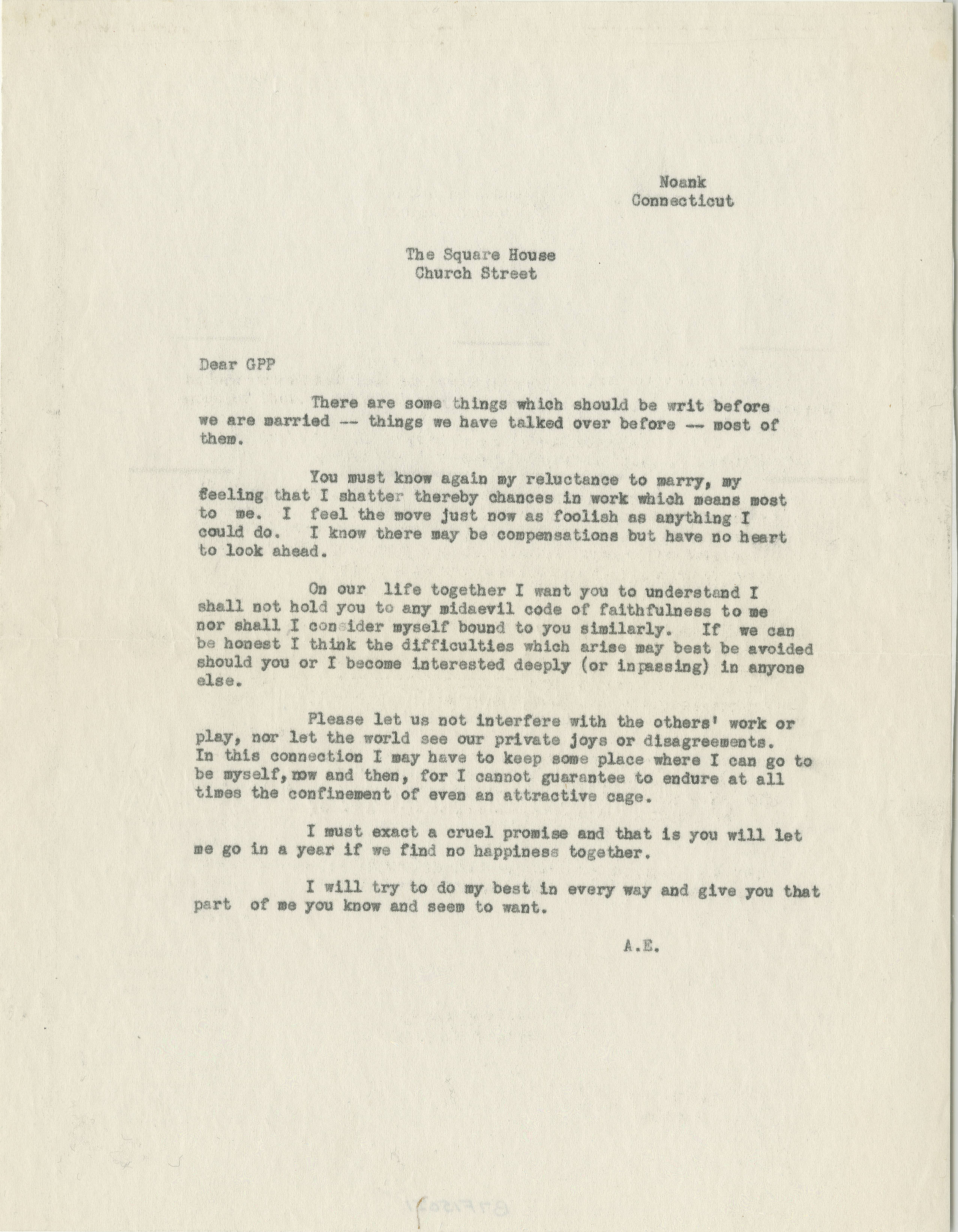
This is the letter Amelia Earhart handed her fiancée George Palmer Putnam on the morning of their marriage in 1931. What a woman!
-
The Taraia Object Is Not Amelia Earhart’s Plane
The leaders of Purdue University’s expedition to determine if the so-called Taraia Object on Nikumaroro is in fact Amelia Earhart’s long-lost plane have concluded, after about two days of radio silence to the outside world, that the object is not Earhart’s Lockheed Electra 10-E.
Evidence gathered at the Taraia Peninsula on Nikumaroro confirmed that the visual anomaly first seen in satellite imagery in 2020 was likely a collection of large trees deposited along the peninsula’s sandspit. By the time the team arrived at the site, a good portion of the debris had fragmented and washed away, leaving only a single Y-shaped segment — a fraction of the anomaly’s original size observed in imagery when the Taraia Object hypothesis was developed. The fragment’s reflective surface, long associated with the idea that the object was a metallic substance, was due to its carbonate veneer. Other items found by the team were similarly coated with a shiny concretized amalgam of coral sand.
Interestingly, Ric Gillespie, founder of TIGHAR — who long advocated the idea that Earhart and Noonan had landed on Nikumaroro and wrote a book to the effect — called it in a YouTube video in December where he said that the Taraia Object was not the plane. He thinks the plane slid off the Nikumaroro reef and is long gone.
-
The Amelia Earhart Expedition Is Underway
Purdue University’s expedition to determine if the so-called Taraia Object on Nikumaroro is in fact Amelia Earhart’s long-lost plane, which was postponed due to bureaucratic hurdles last year, has reached the remote island last Monday. Purdue set out the goals of the expedition as follows:
Expedition members will rendezvous at Tarawa, Kiribati, on Oct. 6 and depart by sea the next day for Nikumaroro in the Phoenix Islands of Kiribati. The team will sail six days to arrive at Nikumaroro and then spend the following days on the small island in the search effort. Work on Nikumaroro will focus on inspecting the Taraia Object, first noticed in satellite imagery in 2020 and later confirmed to be visible on aerial photos taken of the island’s lagoon as far back as 1938. Initial work will include videos and still images of the site prior to any disturbance, followed by remote sensing with magnetometers and sonar. Then the team will employ underwater excavation using a hydraulic dredge to expose the object for identification. Fieldwork will include a walk-over survey of nearby land surfaces to search for debris washed up by waves.
On Wednesday, the expedition crew had started their underwater survey of the object, but then, bad weather prevented further work for three days and the expedition was extended. In a YouTube short posted Saturday night (Sunday morning local time) an expedition crew member explains that the weather has cleared up and that the work can now begin again. So we are awaiting news really any time now as to the actual nature of the Taraia Object. Is it Amelia Earhart’s plane? The suspense is killing me here!
-
The Watchmaker’s Four
Did you ever notice that most wristwatches that use Roman numerals use
IIIIinstead of the more commonIVas the number four hour indicator? Did you ever, like myself, wonder why this is? This way of writing the number four is called “the watchmaker’s four”, apparently. And nobody knows where exactly this tradition originated.What I found is that there are many stories about where the “IIII” on watch dials comes from. None of them, however, have been confirmed by anyone. It’s probably a combination of all those stories together.
I found that to be an interesting read. Now me, personally, I prefer cleaner and more functional designs like classic dive watch baton markers or the most stylish combination, the dot-and-baton design of the Seamaster Professional:

-
Earhart Expedition Postponed
I somehow missed this news, but as it turns out, the expedition to locate Amelia Earhart’s plane has been postponed to the coming year. It seems that bureaucracy on the side of the Kiribati government is to blame. This delay has pushed the departure into the season of cyclones in the South Pacific, which would make it unsafe for the expedition to leave now. Interestingly, cyclone activity is what has uncovered the object in the lagoon, that is of interest to the expedition, in the first place.
In a statement on 27 October, Purdue University, which is organising the expedition, said:
Originally scheduled to launch from Majuro in the Marshall Islands on Nov. 4, the expedition was delayed as the team continues to work through additional stages of the permit approval process with the Kiribati government. A safe departure cannot be later in 2025 with the onset of the South Pacific cyclone season.
The team will continue positive engagement with Kiribati, with plans to go to Nikumaroro as soon as possible and when safe to do so. The plan will remain unchanged: A field team will depart the Marshall Islands and travel by sea for six days to Nikumaroro to confirm whether the visual anomaly seen in satellite and other imagery in the island’s lagoon is what remains of Earhart’s Lockheed Electra 10-E.
“Maritime expeditions require thorough preparation and numerous clearances. Our project required many approvals at multiple levels of the Kiribati government, and we benefited from cooperation and assistance from officials in Tarawa,” said expedition member Steve Schultz, Purdue University’s senior vice president and general counsel. “This is a real-time example of Purdue’s well-known ‘persistent pursuit.’ We have gained valuable insights throughout this process and are very confident and resolved to continue this quest with a planned 2026 departure.”
-
Back from Poland
I’ve just returned from my trip to Poland and the Auschwitz-Birkenau Memorial. It was a very interesting trip, as part of which I not only got a tour of the memorial and museum, but I also had the opportunity to see parts of the memorial not open to regular visitors. We were even shown around a newly-preserved barracks building in Birkenau that had so far only been accessed by museum staff. We also got to see the archives and preservation labs and attended a number of interesting lectures, including by the director of the museum and a staff historian.
It was a very taxing trip. I travelled over 1600 kilometres to get there and back and every day at the memorial, I spent 8 hours straight just absorbing information, with a lot of walking in between. I took over 600 photos on the memorial grounds.
In the coming days and weeks, I will be writing about my experience and you can also expect me to publish some of those pictures here, of course.
-
Auschwitz Seminar
I’ve just gotten the news that I have been accepted to attend a seminar for journalists in Auschwitz at the end of the month. Despite my lifelong interest in World War II history, I have never been there. I have never been in Poland, in fact, even though part of my family is from the now-Polish part of Pomerania. I just never had the opportunity. So I’m doubly happy I get to attend this. This is quite exciting for me!